W
hen architects and interior designers specify planters for a hotel lobby, a corporate atrium or a large-scale outdoor landscape, colour consistency is not a cosmetic preference, it is a practical requirement. A planter that fades within two seasons does not just look neglected. It signals a failure of material quality and it costs the procurement team a replacement cycle that was entirely avoidable.
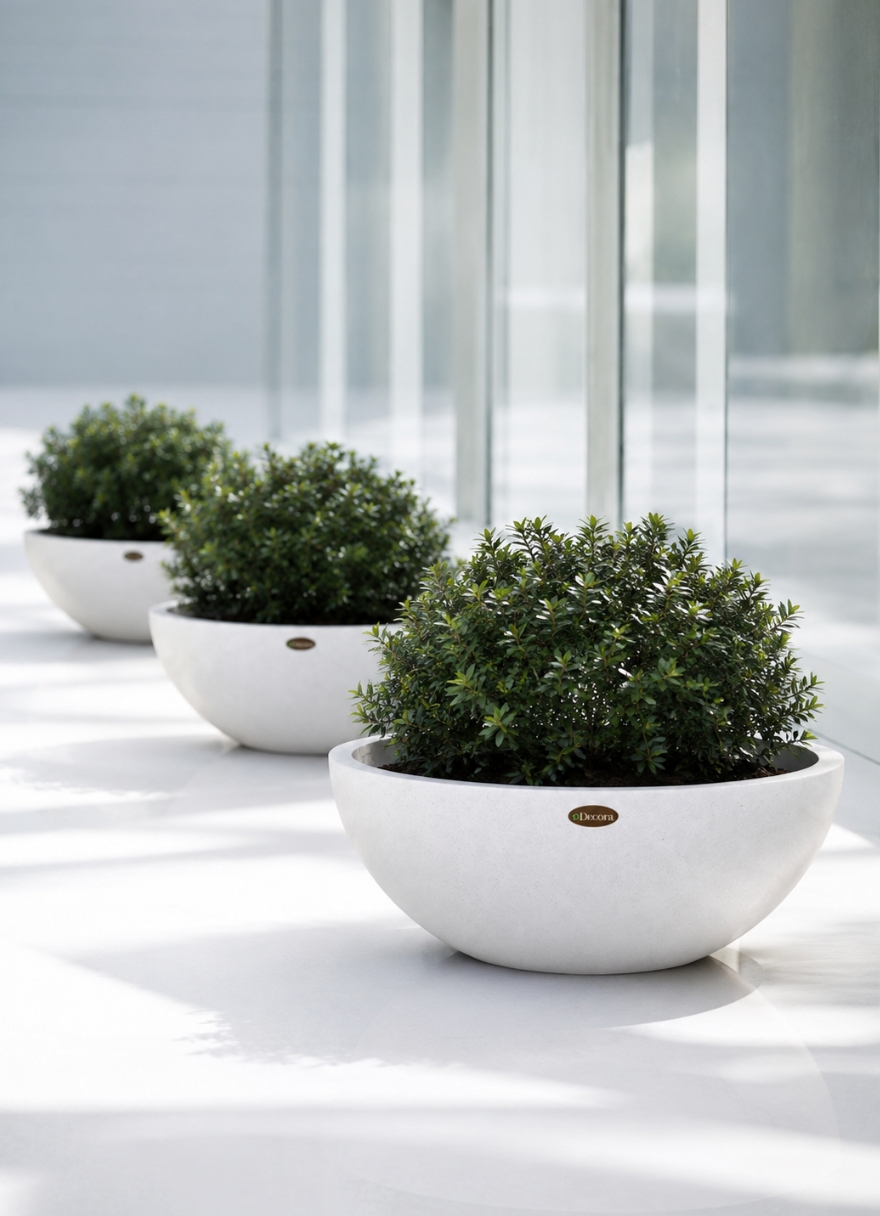
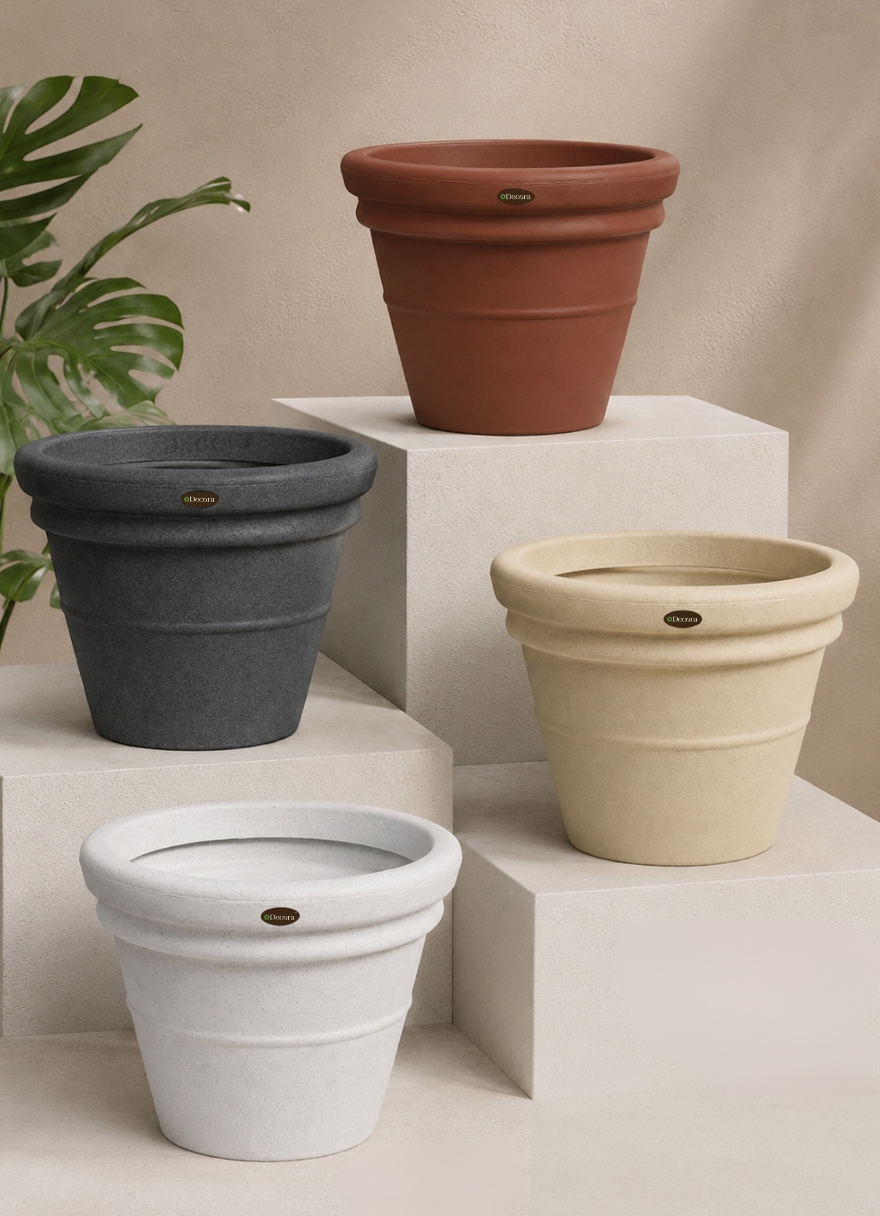
At Decora by Intermolde, non-fading finish is not a feature listed on a spec sheet and left unexplained. It is the result of deliberate material science, applied consistently across 26+ years of polymer planter manufacturing near Mumbai. Whether you are specifying our warm Terracotta, the architectural cool of Grey Stone, the clean neutrality of White Stone or the timeless softness of Marble Beige – each colour is engineered to hold its character for years, not seasons.
This article explains exactly how that works and why it matters to every designer, facility manager and commercial buyer making long-term decisions about their spaces.
Why Do Planters Fade in the First Place?
To understand how Decora prevents fading, it helps to understand what causes it. Colour degradation in planters typically happens through one or more of the following mechanisms:
UV Radiation: Ultraviolet rays from sunlight break down the chemical bonds in pigment molecules, causing colours to bleach, shift or become chalky over time. A warm Terracotta becomes washed-out. A deep Grey Stone turns pale and uneven. This is the primary cause of fading in outdoor applications.
Oxidation: Exposure to oxygen – particularly in humid or coastal environments common across India – accelerates surface degradation and dulls the original finish.
Thermal Stress: Repeated cycles of heat and cooling cause lesser-quality materials to expand and contract, breaking down the surface layer and causing colour to lift or crack. This is especially damaging to delicate tones like Marble Beige, where even minor surface shifts are immediately visible.
Inferior Pigment Quality: Not all pigments are created equal. Low-grade colorants dispersed in the polymer matrix provide initial visual appeal at a lower cost – but they are the first thing to fail. A White Stone that begins to yellow or a Grey Stone that chalks unevenly, is almost always the product of under-specified pigmentation.
Terracotta, ceramic and standard plastic planters are all vulnerable to at least one of these forces. High-grade polymer, when formulated correctly – addresses all of them.
The Material Science Behind Decora's Non-Fading Colours
1. UV-Stabilised Polymer Compounds
Decora’s planters are manufactured using UV-stabilised polymer compounds specifically formulated to resist photodegradation. UV stabilisers work at the molecular level by absorbing or reflecting UV radiation before it can attack the pigment or the polymer matrix itself.
There are two primary categories of UV stabilisers used in high-performance polymer products:
UV Absorbers capture UV radiation and convert it into heat, which is then dissipated harmlessly. This prevents the energy from reaching and breaking down the pigment molecules embedded in the material – keeping a Marble Beige looking warm and consistent and a White Stone looking clean rather than yellowed.
Hindered Amine Light Stabilisers (HALS) work differently, they neutralise free radicals generated by UV exposure, interrupting the chain reaction of oxidative degradation that causes fading, chalking and surface embrittlement.
The combination of both within a well-formulated compound is what separates a Decora planter that looks the same after five years from a competing product that begins to fade within the first Indian summer.
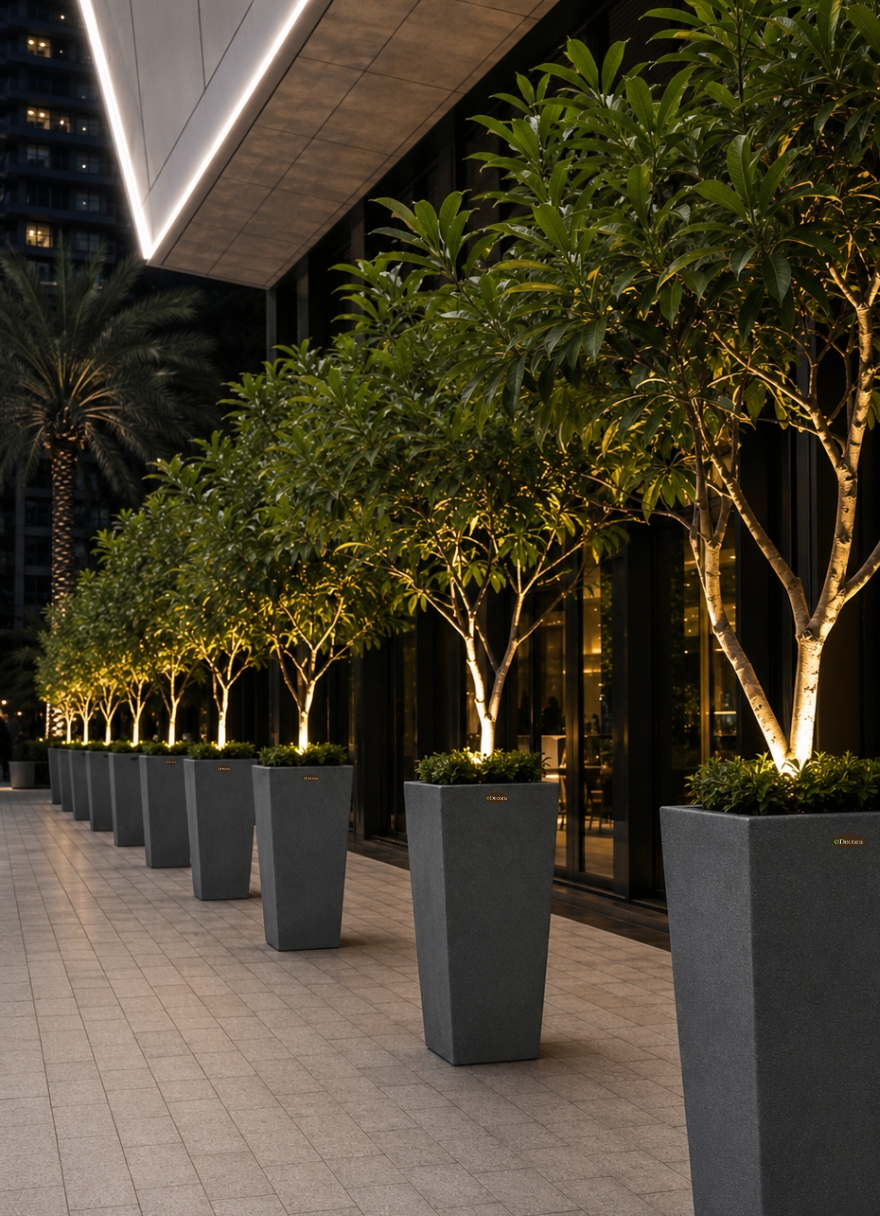
For commercial buyers specifying planters for outdoor terraces, building facades or streetscapes – where Grey Stone or Terracotta tones are popular architectural choices – UV stabilisation is not an optional upgrade. It is the foundation of any product that claims durability in the Indian climate.
2. High-Grade, Colour-Fast Pigmentation
Even the best UV-stabilised polymer base will underperform if the pigments used are low quality. Decora uses high-grade inorganic and organic pigments selected specifically for their lightfastness – a measure of how resistant a colorant is to fading when exposed to light.
Pigments are rated on the Blue Wool Scale from 1 to 8, where 8 represents the highest resistance to fading. Commercial-grade polymer products intended for long-term outdoor or semi-outdoor use require pigments at the higher end of this scale. This standard applies equally across all four of Decora’s colour variants.
Each colour presents its own pigmentation challenge:
White Stone demands exceptional purity and resistance to yellowing – one of the most demanding performance requirements in polymer pigmentation.
Grey Stone requires precise balance between cool and warm undertones and must hold that balance uniformly across thousands of units in a production run.
Marble Beige is a complex, layered tone where any shift in the ratio of pigment components becomes immediately apparent. Consistency here is a mark of manufacturing discipline.
Terracotta contains warm oxide-based pigments that are highly susceptible to UV bleaching in lower-grade products. In Decora’s formulation, these warm earth tones are fully stabilised to retain their depth without becoming pale or uneven.
Beyond raw lightfastness, pigment dispersion within the polymer matrix matters enormously. Poorly dispersed pigment creates microscopic weak points where concentration is uneven and degradation begins first. Decora’s manufacturing process ensures consistent, thorough dispersion throughout the material – so colour performance is uniform across the entire surface and across large batch orders.
For commercial projects where planters are specified in bulk – corporate campuses, hotel properties, retail chains – this consistency across production runs is not a minor detail. It is the difference between a cohesive visual scheme and one that looks mismatched within 18 months.
3. Precision-Controlled Manufacturing Process
Material formulation is only part of the equation. How that material is processed during manufacturing directly affects the final product’s durability.
Temperature Control: During polymer processing, maintaining precise temperature windows ensures that UV stabilisers and pigments are evenly integrated into the compound without degradation from overheating. Excessive heat during manufacturing can compromise the very additives designed to protect the finished product.
Moulding Consistency: Decora’s facility near Mumbai operates with tight tolerances in the moulding process. Consistent wall thickness across every planter ensures that UV stabilisers and pigments are distributed evenly throughout the product – not concentrated in certain areas and absent in others.
Surface Finish Quality: The final surface of a Decora planter – whether the high-gloss finish of the Glossy range or the soft, absorbed-light quality of the Matt range – is not simply cosmetic. A smooth, dense, non-porous surface provides an additional physical barrier against the elements. Micro-porous surfaces, common in lower-quality polymer products, allow moisture and airborne contaminants to penetrate and accelerate surface degradation from within.
Colour Meets Finish: Glossy and Matt Across All Four Variants
Decora’s four colours – White Stone, Grey Stone, Marble Beige and Terracotta, are available across both finish ranges. The choice of finish affects not just aesthetics, but also how each colour performs in specific environments.
Glossy Pots – Where Colour Commands the Room
Decora’s Glossy Pots feature a high-sheen, reflective surface that interacts dynamically with both natural and artificial light. The dense, smooth surface of the gloss finish provides excellent resistance to surface contamination – dust, grime and moisture sit on the surface rather than being absorbed.
In this finish, each colour takes on a particular character. White Stone in gloss is crisp and luminous – ideal for hotel lobbies and high-end retail where cleanliness of form matters. Grey Stone becomes architectural and precise. Marble Beige develops a warmth and depth that reads as genuinely luxurious. Terracotta in gloss is bold and grounding – a confident material statement in commercial entrance spaces.
For interior commercial spaces where visual impact and minimal maintenance are equally important, Glossy Pots deliver the highest-performance choice for sustained colour vibrancy.
Matt Pots – Where Colour Breathes
Decora’s Matt Pots absorb light rather than reflecting it, creating a sense of quiet depth that suits contemporary offices, wellness spaces and boutique hospitality environments. The non-reflective surface is particularly well-suited to outdoor commercial applications, where a glare-free finish reads with greater sophistication in direct sunlight.
In matt, the colour story shifts. White Stone becomes softer – less clinical, more considered. Grey Stone in matt has a raw material quality that sits beautifully in minimalist architectural interiors. Marble Beige feels closest to its natural stone reference in this finish – grounded, textured, warm. Terracotta in matt carries the same earthy confidence as its glossy counterpart, but with a restraint that works especially well in landscape and garden contexts.
It is worth addressing a common misconception: that matt finishes are more susceptible to fading because they lack a reflective barrier. In lower-quality products, this can be true. In Decora’s Matt range, the same UV-stabilised compound and high-grade pigmentation used in the Glossy range ensures that the matt surface holds its character without dulling, chalking or shifting in tone – even in fully exposed outdoor settings.
What This Means for Commercial Buyers
For architects, interior designers, facility managers and procurement teams, the non-fading performance of Decora planters translates into three practical advantages:
Lower Total Cost of Ownership: A planter that retains its finish for the life of the installation does not need to be replaced. For commercial projects with dozens or hundreds of planters – all specified in a single colour like Grey Stone or Marble Beige – the cumulative cost of premature replacement is significant. Decora’s colour durability eliminates this cycle entirely.
Visual Consistency Across Time: Commercial spaces are judged by the consistency of their environments. A scheme that begins to look mismatched because individual planters are fading at different rates undermines the entire design intent. Uniform colour retention across all units, maintained over years, protects the visual integrity of the space.
Reduced Maintenance Overhead: Planters that fade tend to also surface-degrade – developing chalky, rough or discoloured patches that are difficult to clean and impossible to restore without replacement. Decora’s non-porous, UV-stable surface simply does not do this. Maintenance is a wipe-down, not a restoration project.
The Decora Standard: 26+ Years of Colour You Can Rely On
Decora by Intermolde has been supplying premium polymer planters to leading businesses across India – including The Leela, Godrej, L&T and Reliance Infrastructure – for over 26 years. The non-fading performance of our products is not a claim made in a catalogue. It is validated by the longevity of our client relationships, the repeat orders placed by commercial accounts, and the visible condition of our planters in installations that have been in place for years.
When you specify a Decora planter in White Stone, Grey Stone, Marble Beige or Terracotta – you are specifying a product whose colour will look the same in five years as it does on the day of installation. In commercial design, that is a rare and valuable guarantee.
Conclusion
Colour that lasts is not accidental. It is the product of UV-stabilised compounds, high-grade lightfast pigmentation, controlled manufacturing precision and a surface quality that provides genuine physical protection against the elements.
At Decora by Intermolde, these are not optional features applied to select products. They are built into every planter we manufacture – across both Glossy and Matt finishes and across all four colour variants – because we believe that a product which cannot hold its colour has no place in a considered commercial space.
If you are specifying planters for a large-scale project and have questions about colour performance, finish options or bulk ordering, our team is available to advise.
Enquire: enquire@intermolde.com | +91 9320 026 594 | www.intermolde.com
Explore Decora’s full product range: Glossy Pots | Matt Pots