T
here is a quiet revolution happening in how commercial spaces in India are being designed. Walk into a newly fitted Grade-A office in BKC, Mumbai or step through the lobby of a boutique hotel in Pune or Bengaluru, and you will notice something different. Greenery is no longer an afterthought, it is part of the architectural brief.
Behind every well-placed plant in a high-end commercial interior is a decision that most guests never consciously register: the choice of planter. And increasingly, across India’s most discerning design studios and architecture firms, that choice is polymer.
At Decora by Intermolde, we have spent over 26 years working alongside architects, interior designers, landscape consultants, and commercial developers across India. This is what we have observed and why premium polymer pots have become the specification of choice for serious design professionals.
The Shift: Greenery as a Design Element, Not a Decoration
For years, plants in commercial spaces were treated as furniture – something added after the main design decisions had been made. A terracotta pot in the corner. A plastic planter near the reception. An afterthought.
That era is over.
In 2025 and beyond, India’s most progressive commercial spaces – from IT parks in Hyderabad and Koramangala to hotel lobbies in South Mumbai are being designed with greenery as a primary spatial element. Biophilic design, once a Western concept, is now a mainstream specification in Indian commercial interiors. Research from the Indian Institute of Human Settlements confirms what design professionals have long sensed: integrating natural elements into offices can improve employee well-being by up to 21% and reduce workplace stress by 34%.
The planter is no longer incidental. It is structural. And when a planter is structural, when it defines a reception, anchors a corridor or frames a lobby entrance – the material it is made from matters enormously.
Why Architects in India Are Choosing Polymer Pots
Polymer pots offer a combination of properties that no other material quite matches for large-scale commercial applications in India. Here is what design professionals are specifying and why.
1. Precision Form That Holds Across Scale
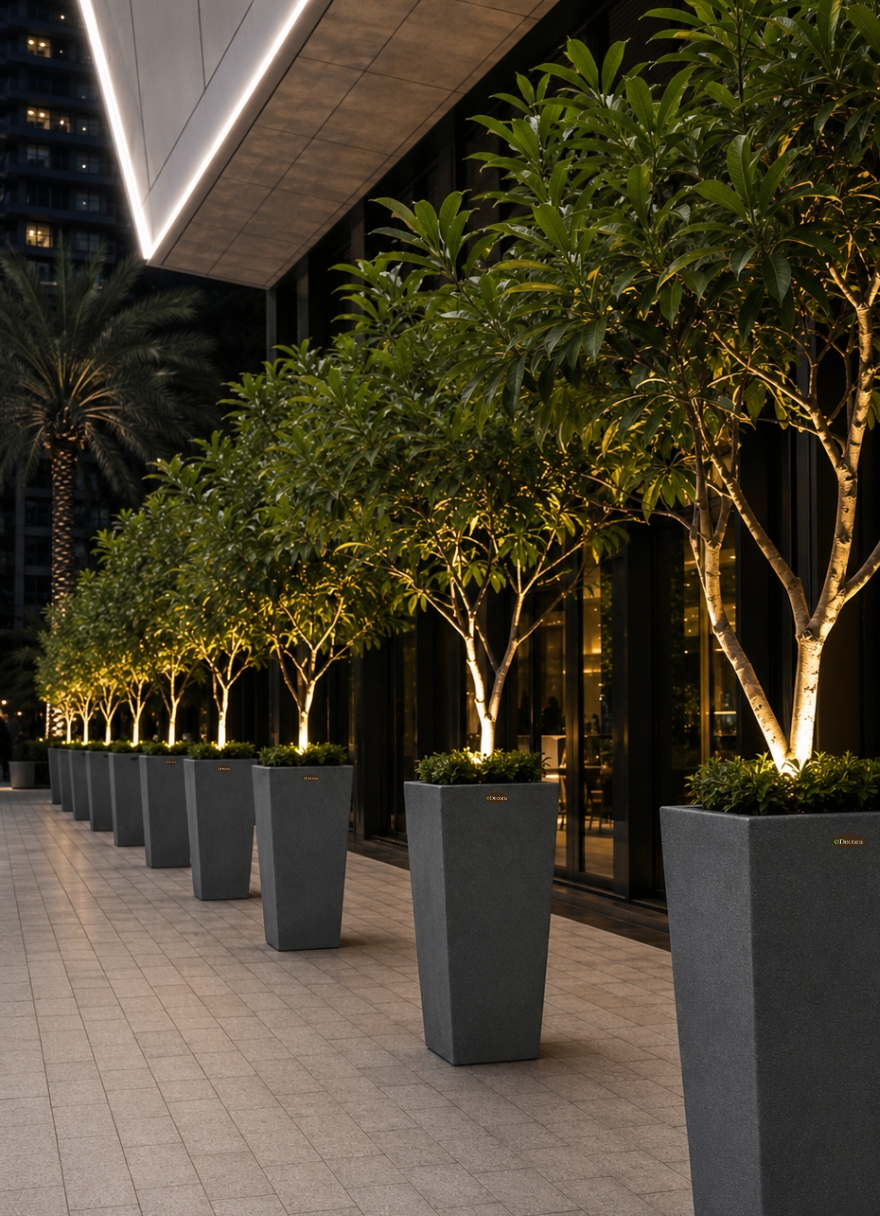
Polymer manufacturing allows for exact replication of geometry across any number of units. When an architect specifies 40 identical cylindrical planters for a corporate campus corridor or a hotel designer requires 12 matching rectangular pots for a rooftop restaurant, consistency matters. Polymer delivers it.
At Decora, our pots are precision-crafted to maintain exact proportions, rim profiles and finish quality across the entire production run – whether you order 5 pieces or 500. This is the kind of manufacturing discipline that architects building at scale cannot compromise on.
2. Weight-to-Strength Ratio for High-Rise and Elevated Spaces
India’s commercial real estate boom is vertical. Offices on the 14th floor. Hotel terraces on the 8th. Rooftop gardens above basement parking. For any planter going into an elevated structure, weight is a real engineering constraint – not just a convenience.
Premium polymer pots are significantly lighter than concrete, GRC, or even FRP equivalents, without sacrificing structural integrity. This makes them the practical choice for terraces, mezzanines and upper-floor commercial interiors where load calculations are part of the brief.
3. Climate Performance Across India’s Diverse Conditions
India does not have one climate, it has dozens. Mumbai’s year-round humidity. Delhi’s extreme temperature swings from 45°C summers to near-zero winters. Chennai’s prolonged monsoons. Pune’s mix of dry heat and wet seasons.
Premium polymer pots are UV-stabilised, moisture-resistant, and do not crack, fade or warp under thermal cycling. For an architect specifying planters for an outdoor commercial plaza or a hotel pool deck, this durability is non-negotiable. Unlike ceramic pots that chip or terracotta that stains and flakes, well-made polymer planters maintain their finish for years – protecting both the design intent and the client’s investment.
4. Finish Quality That Earns Specification
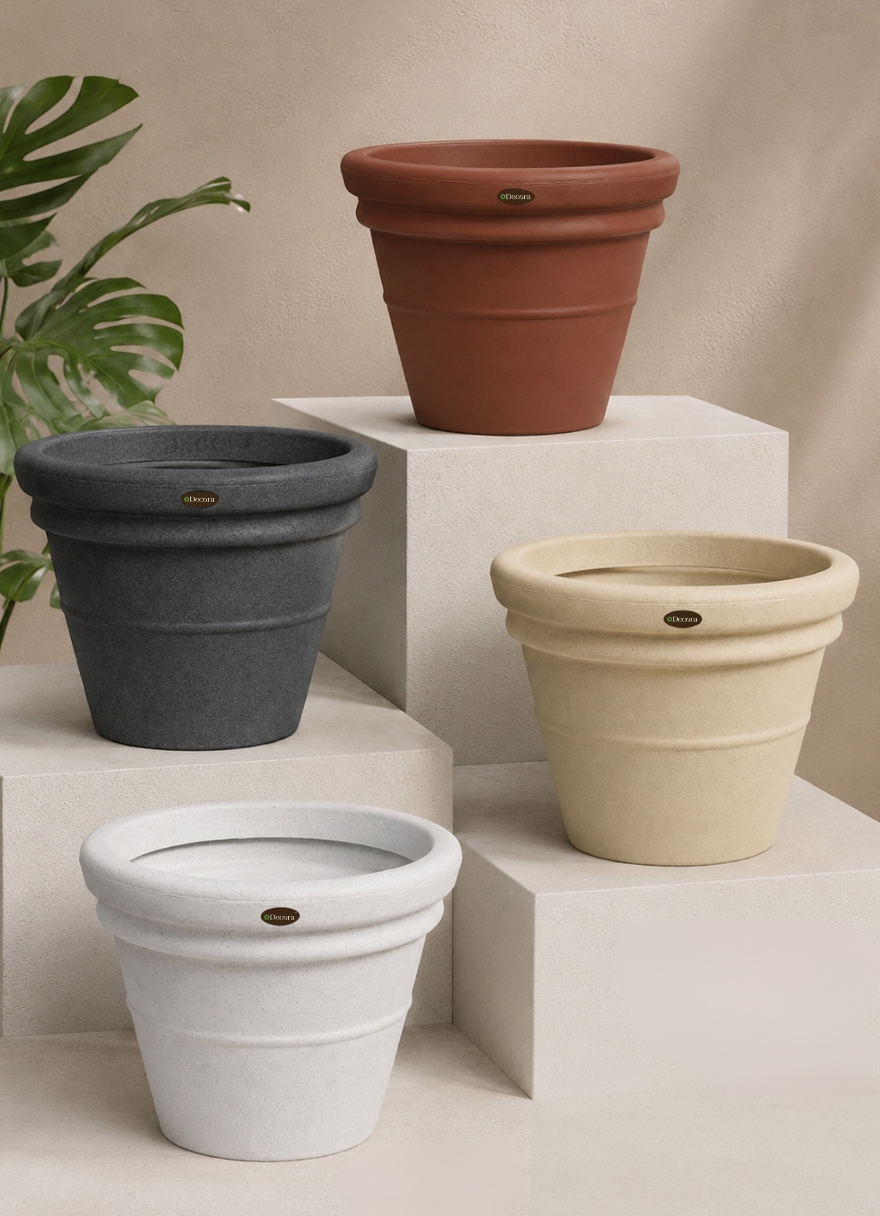
This is where Decora is distinct. Our polymer pots are available in two signature finishes – Glossy and Matt – each engineered to perform in commercial environments, not just look good in a showroom.
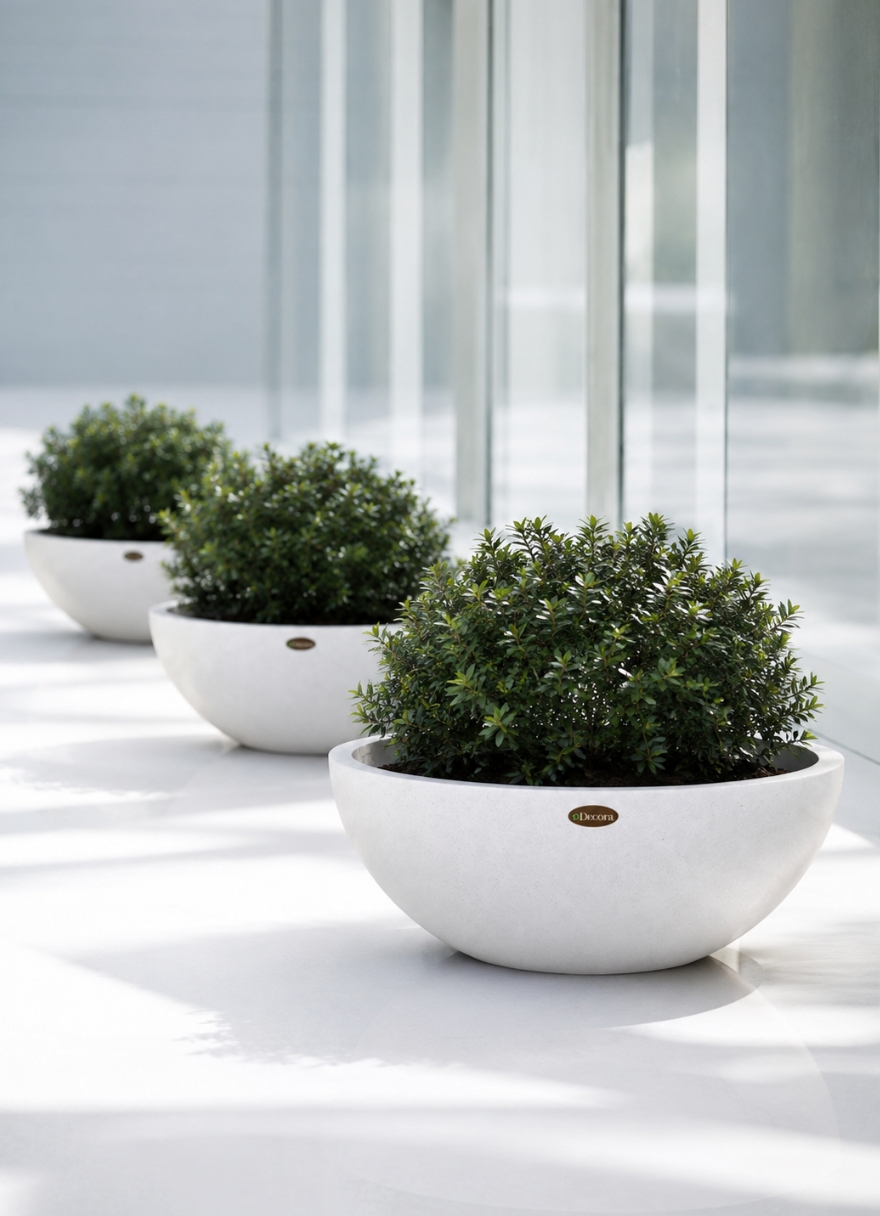
Glossy finish pots reflect light cleanly, making them ideal for high-ceilinged hotel lobbies, restaurant interiors, and luxury residential lobbies where the planter needs to hold its own alongside marble floors and premium lighting. The reflective surface adds depth and visual energy without being aggressive.
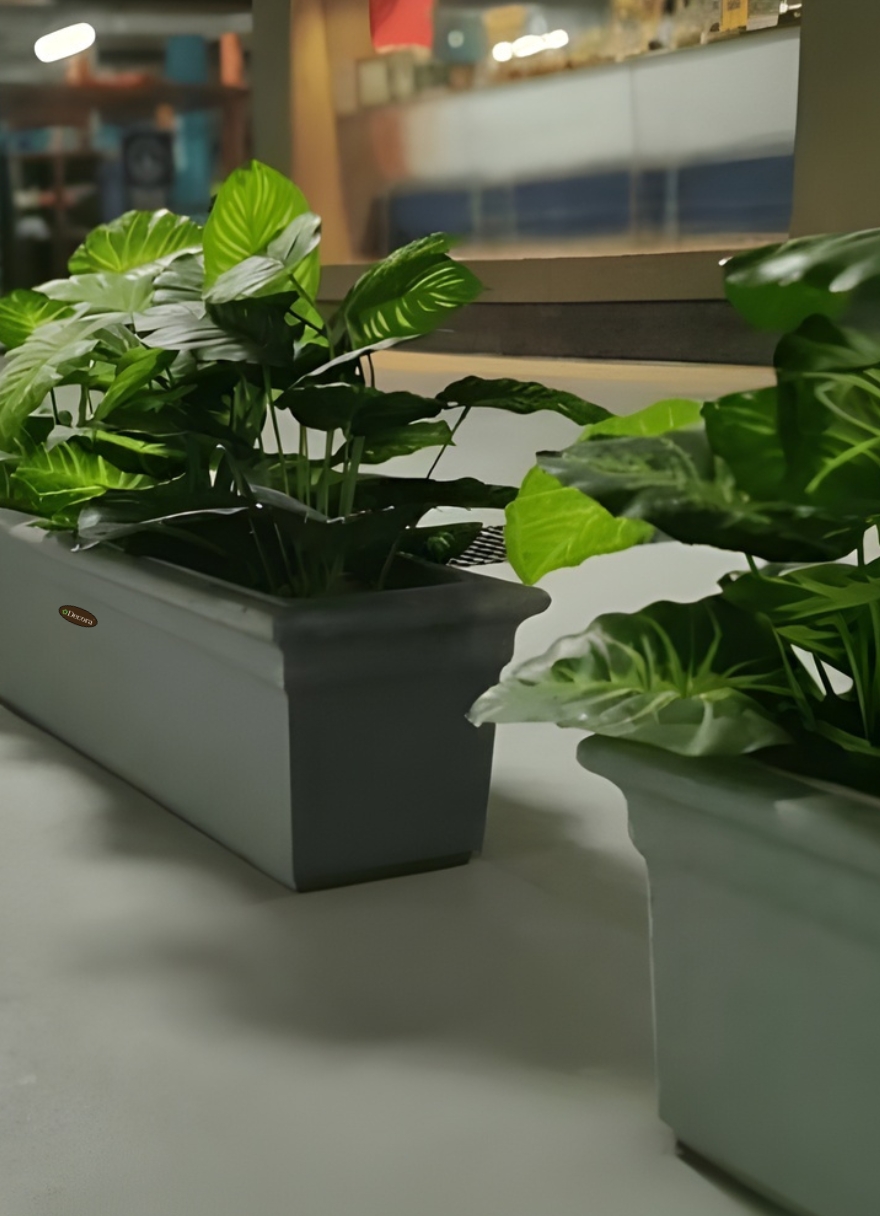
Matt finish pots offer a quieter, more sophisticated presence. They suit corporate offices, co-working spaces, and hospitality interiors where the design language is calm, textural and restrained. Matt surfaces absorb light rather than reflecting it, creating a sense of solidity and premium weight.
The choice between the two is an aesthetic and spatial decision – something Decora’s team is always available to help design professionals work through for specific projects.
Where Commercial Designers Are Using Polymer Pots: A Room-by-Room View
Hotel Lobbies
The lobby is a brand statement. Every material, finish, and form contributes to the first impression a guest forms and retains. Large-format Decora polymer pots in glossy or matt finishes anchor lobby spaces with architectural confidence. Paired with statement plants like the Fiddle Leaf Fig, Bird of Paradise or a sculptural Cycad, they create the kind of composed, living entrance that photographs beautifully and reads as intentional to every guest who walks through the door.
Corporate Office Receptions and Corridors
India’s Grade-A offices – particularly in the emerging GCC (Global Capability Centre) sector – are investing heavily in workplace experience. Biophilic elements are a significant part of that investment. Polymer pots placed along corridors, in reception zones and at lift lobbies bring greenery into the daily circulation path of employees, contributing to the calmer, more human-scaled environment that high-performance workplaces require.
Restaurants and Cafés
The hospitality food-and-beverage sector in India is designing with increasing sophistication. Planters are being used to create soft partitions between dining zones, to define outdoor seating boundaries and to add organic texture to interiors that would otherwise feel hard and constructed. Matt finish polymer pots are particularly popular here, their restrained surface lets the plant and the space take the lead.
Co-Working Spaces
India’s co-working sector – from Bengaluru’s Koramangala to Delhi’s Connaught Place – is one of the fastest-growing commercial real estate segments. Operators compete intensely on the quality of the environment they offer. Polymer planters with consistent geometry and premium finish signal investment in quality without the maintenance overhead of more fragile materials.
Retail and Mixed-Use Developments
Large retail developments, mixed-use projects, and high-street commercial properties are increasingly using planters to humanise what could otherwise feel like purely transactional spaces. At this scale, durability, consistency and the ability to procure identical units in large quantities are critical. Polymer delivers on all three.
The Specification Decision: What to Ask Before You Specify
For architects and interior designers working on commercial briefs, here are the key questions that should inform the planter specification:
1. What is the load tolerance of the floor or terrace? If weight is a constraint, polymer is almost always the correct material choice.
2. What is the light condition in the installation zone? Low-light interior corridors suit matt finish pots for their quiet presence. Bright lobbies and sun-drenched terraces suit glossy finish for their visual energy.
3. What is the quantity required and how critical is consistency? For large-quantity commercial specifications, precision manufacturing is essential. Decora’s process ensures dimensional and finish consistency across every unit in a production run.
4. What is the maintenance regime for the project? Polymer pots require minimal maintenance – a wipe-down is sufficient. For commercial projects with limited on-site maintenance budgets, this is a significant practical advantage over terracotta or unglazed ceramic alternatives.
26 Years of Commercial Projects Across India
Decora by Intermolde has been supplying architects, interior designers, landscape consultants and commercial developers across India since 1998. Our work spans hospitality, corporate, retail, and residential interiors – from individual residences to large-scale commercial roll-outs across multiple sites.
Our process is built around design professionals. We understand how a specification evolves from a concept sketch to a procurement order. We understand lead times, site conditions and the need for product consistency. And we understand that the right planter is not simply the one that looks best in isolation, it is the one that serves the space, the brief and the long-term design intent.
You can explore the range of completed projects and finishes in our Gallery or get in touch with us directly to discuss your current commercial project.
Closing Thought: The Planter as Architecture
The best commercial interiors in India today have one thing in common: every element has been considered. The material. The finish. The proportion. The way a surface catches or absorbs light. The way a form reads from 20 metres and from 2.
A planter that has been thoughtfully specified – in the right material, the right finish, and the right scale – does something quietly remarkable. It completes the space. It makes greenery feel like it was always meant to be there.
That is the Decora philosophy. And it is why architects and interior designers across India keep specifying our polymer pots – not because they are the loudest option in the room, but because they are precisely right for it.